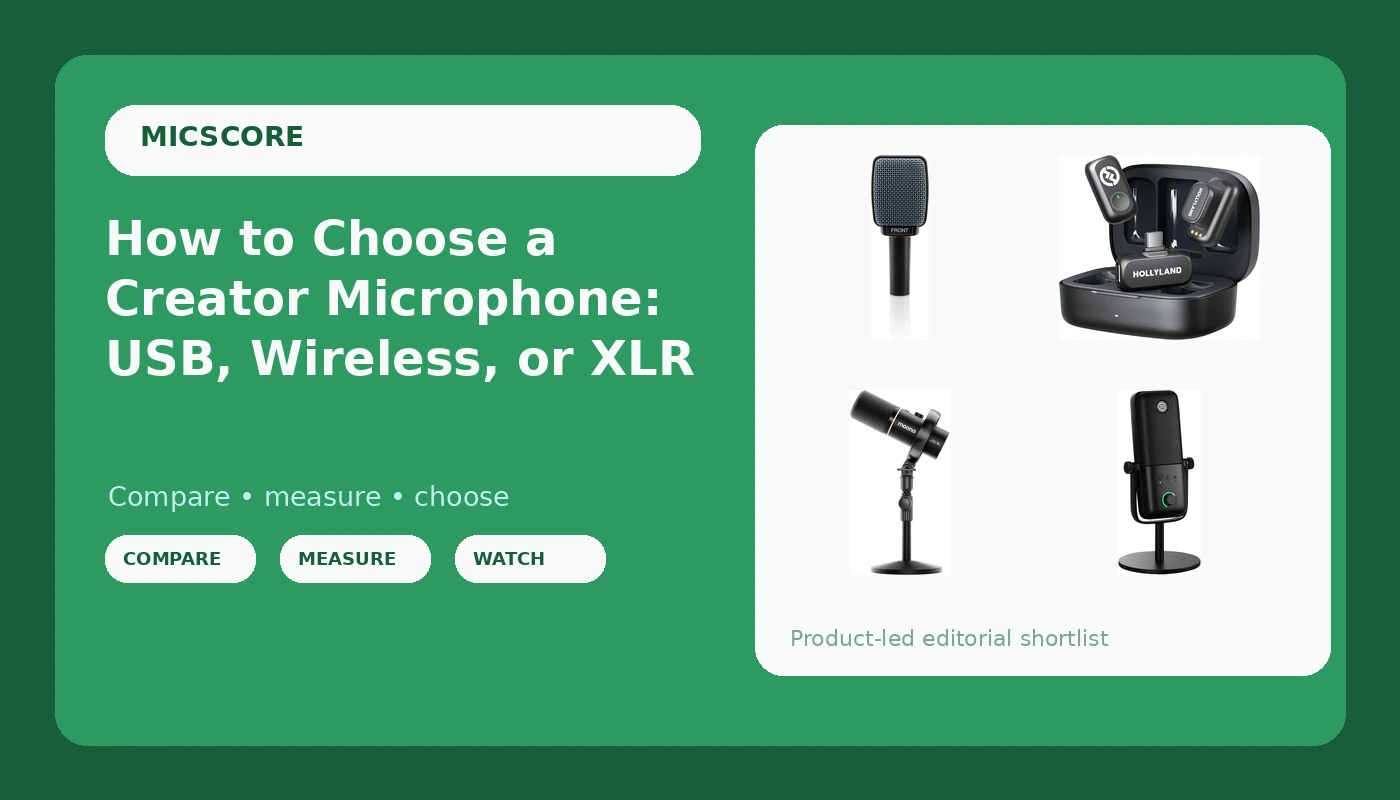
Buying a microphone for creators has never offered more directions, and that is the whole problem. There are clip-on wireless systems that record straight to a phone, hybrid mics that speak both XLR and USB, USB condensers with processing built into the hardware, and classic pro audio dynamics that have been on stages for years. Each one is good at something, and none of them is good at everything. The useful question is not which model wins an argument on a forum. It is which design fits the room you record in, the device you record to, and the amount of setup you will tolerate before you stop pressing record at all.
Related: Dynamic vs Condenser Microphones for a Home Podcast →
Quick answer
Match the connection type to the job before you compare models. If you record to a phone or a camera and you need to move, a wireless clip-on kit such as the Hollyland Lark A1 is the direct fit. If you want one microphone that works untethered today and on an XLR interface later, the MAONO PD200W covers both paths. If you record at a desk from a PC and want the processing handled in the microphone, the Elgato Wave:3 MK.2 is the USB option. If you already own an interface and want a rugged dynamic for loud, close sources, the Sennheiser E906 is the pro audio pick.
Four useful options
| Model | Best fit | What stands out |
|---|---|---|
| Hollyland Lark A1 (2TX+USB-C RX+Charging Case) Wireless Magnetic Microphone | Recording to phone or camera while moving | Two transmitters, a USB-C receiver, and a charging case in one kit |
| MAONO PD200W Hybrid Wireless Podcast Microphone for PC, Dynamic XLR USB Mic | One mic that works wirelessly, over USB, and over XLR | Dynamic capsule with wireless, USB, and XLR paths |
| Elgato Wave:3 MK.2 USB Condenser Microphone, DSP Effects | Desk recording from a single computer | USB condenser with onboard DSP effects |
| Sennheiser Pro Audio E906 Microphone, black | Close-miking loud sources through an interface | Supercardioid dynamic from a legacy pro audio line |
The wireless pick: Hollyland Lark A1 (2TX+USB-C RX+Charging Case) Wireless Magnetic Microphone
Wireless clip-on systems solve one specific problem: distance from the computer. If your recording happens while you walk, cook, or hold a camera, a cable is the thing that limits you, and no amount of preamp quality fixes that. The trade-off is that a small transmitter has a tiny capsule and sits inches from the mouth, so placement does more work than any setting in a menu. That is usually an advantage in a home space. A close microphone with a small pickup pattern hears less of the room than a large one across the desk, which is why a wireless clip-on can sound cleaner in an untreated bedroom than a much more expensive studio microphone placed badly. Budget for battery habits rather than sound quality: charge the case the night before, and check levels before the take you cannot repeat.
The hybrid pick: MAONO PD200W Hybrid Wireless Podcast Microphone for PC, Dynamic XLR USB Mic
The hybrid idea is the most interesting thing happening at the entry level right now, because it removes the two decisions people regret most. A dynamic capsule is generally less sensitive to the room than a condenser, which matters if you record in a kitchen or a bedroom with traffic outside. And the XLR path is what makes this a long-term purchase rather than a starter one: when you eventually buy an interface, the microphone does not become a paperweight. The honest trade-off is that any microphone trying to do three jobs is not the specialist at any one of them. If you already know you will only ever record at a desk over USB, a dedicated USB microphone is simpler. If you know you want an interface eventually, this is the path that lets you start today without rebuying.
The desk USB pick: Elgato Wave:3 MK.2 USB Condenser Microphone, DSP Effects
Condensers became the studio default because they capture detail that dynamics smooth over, and the same sensitivity that makes them flattering in a treated room makes them unforgiving everywhere else. That is not a reason to avoid the category, it is a reason to take microphone position seriously: close, angled slightly off axis from the keyboard, with something soft behind the speaker and the microphone pointed away from the computer. Onboard DSP is the quiet advantage of this class of microphone. Compression and EQ applied in the hardware happen before the signal reaches a recording app, which means the file you capture is already closer to finished, and you spend less time fixing levels after the fact. The limitation to accept is that a USB condenser is a desk instrument. It is not the microphone you take outside.
The XLR dynamic pick: Sennheiser Pro Audio E906 Microphone, black
This is the odd one out in this group, and it is here on purpose. It is not a podcast microphone in the way the others are. Its design target is instruments and amplifiers, where a tight pattern and a body that survives a stage earn their keep, and it has been a standard on loud sources for years. For voice it works best close and slightly off axis, and it needs an interface or mixer that can supply clean gain, because a dynamic microphone of this type asks more of a preamp than a USB microphone ever will. The reason to consider it is durability and predictability. It is the kind of microphone you keep for fifteen years, use on a guitar cabinet on Saturday, and still pull out for a loud, close, no-nonsense voice session. The reason to skip it is that it solves a problem most home recorders do not have.
Prices and availability may change. Product images, names, and retailer links are matched to verified listings. No current price, rating, stock status, or measured result is stated here without current evidence.
What the three connection types actually change
Wireless clip-on systems replace the cable with a radio link and a receiver. You gain freedom of movement, fast setup, and phone or camera compatibility. You give up battery management, some capsule size, and a small amount of setup predictability, since a receiver dongle is one more thing that can be unplugged at the wrong moment.
USB microphones fold the interface into the microphone. One cable, no gain knob to misunderstand, and in this class often some processing built in. You gain simplicity and a shorter path to a finished-sounding file. You give up the ability to swap preamps later, and you are tied to a computer for recording.
XLR microphones are the modular path. The microphone is one purchase, the interface is another, and either can be replaced independently. You gain upgrade flexibility and typically more headroom for loud sources. You give up the simplicity of a single cable, and you accept that the total cost of the first setup is higher than the price of the microphone alone.
None of these is better in the abstract. Each one is better for a specific recording situation, which is why the answer changes the moment you describe where and how you record.
How to decide in five steps
- Name the device you record to. Phone, camera, and PC lead to different answers, and no single purchase fixes a mismatch.
- Count the people on microphone. Two speakers on one receiver is a different requirement from one person at a desk.
- Judge your noise floor honestly. Sit in the room, stay silent for thirty seconds, and listen to what is audible. That noise is what your microphone will capture.
- Decide whether you want to grow into an interface. If yes, buy the XLR-capable path now and skip the intermediate purchase.
- Budget for the stand, arm, and filter before you consider a microphone upgrade. A desk stand that transmits typing noise will undo a better microphone.
Setup habits that matter more than the microphone
- Speak close. Distance is the single largest variable in how much room you hear, and it costs nothing to change.
- Use a boom arm or a proper stand so the microphone is off the desk and away from keyboard vibration.
- Add a pop filter or a foam windscreen and learn where plosives land, then angle the microphone slightly off axis.
- Set gain so normal speech peaks well below clipping, then leave the knob alone for the whole session.
- Record thirty seconds of room tone at the start and listen back before you commit to a long take.
Which option should you choose?
Choose the Hollyland Lark A1 (2TX+USB-C RX+Charging Case) Wireless Magnetic Microphone when you record to a phone or camera and need to move while you talk, or when two people need to be captured from one receiver. Choose the MAONO PD200W Hybrid Wireless Podcast Microphone for PC, Dynamic XLR USB Mic when you want one microphone that works untethered now and on an interface later, and you record in a room you cannot treat. Choose the Elgato Wave:3 MK.2 USB Condenser Microphone, DSP Effects when your recording is always at a desk, always on a computer, and you want processing handled before the file is saved. Choose the Sennheiser Pro Audio E906 Microphone, black when you already own an interface, you record loud sources close up, and you want a dynamic that will still be working in a decade.
The caveat is that this comparison is about design and fit, not measured performance. Connection type, capsule type, and placement habits explain most of the difference between these options. If your room is noisy and your microphone is far from your mouth, changing the microphone will not fix the recording.
The bottom line
Pick the connection type that matches your recording situation, then pick the model that fits inside it. Wireless when you move, USB when you sit at a computer, XLR when you own an interface and want a microphone you can keep. Before you spend on an upgrade, spend an afternoon on placement: closer to the mouth, further from the desk, with something soft in the room. That change is free, it survives every future gear purchase, and it does more for a recording than any single model in this list.