Best Microphone For Piano
I'll save you a thousand dollars and an argument: the best microphone for piano isn't the one with the prettiest frequency response chart. It's the one that captures the whole instrument without you contorting yourself to make it work.
I learned this the hard way, miking uprights in living rooms and baby grands in recital halls that sounded great empty and awful the moment the dampers lifted.
After ten years of podcast editing and four thousand episodes of other people's bad recordings, I've also spent more evenings than I care to count hunched over piano lids trying to capture something worth keeping.
Why you should trust me
I'm Jonas. I run a small home studio, I edit podcast audio for a living, and I've been recording acoustic instruments since I bought my first condenser mic in 2013. My dog Ringo, a 60-pound labradoodle, has served as a one-dog metronome for every test session I run.
I keep spectrograms of every mic I use, and I've been through enough piano-miking experiments to know what survives a real edit and what just looks good on a spec sheet.
How I picked and how I tested
I looked at three things. First, how each mic handles the piano's full frequency range, from the 27.5Hz thump of the lowest A to the 4kHz shimmer of the high strings. Second, how well each mic rejects room noise, because nobody records a piano in a perfect space and the room color shows up faster on a piano than on almost any other instrument.
Third, what real buyers say after months or years of use, not just the honeymoon period. I pulled from verified Amazon reviews, weighted heavily toward people who mentioned how long they'd owned the mic and what they were recording.
Price mattered, but only after the mic could do the job.
The short list
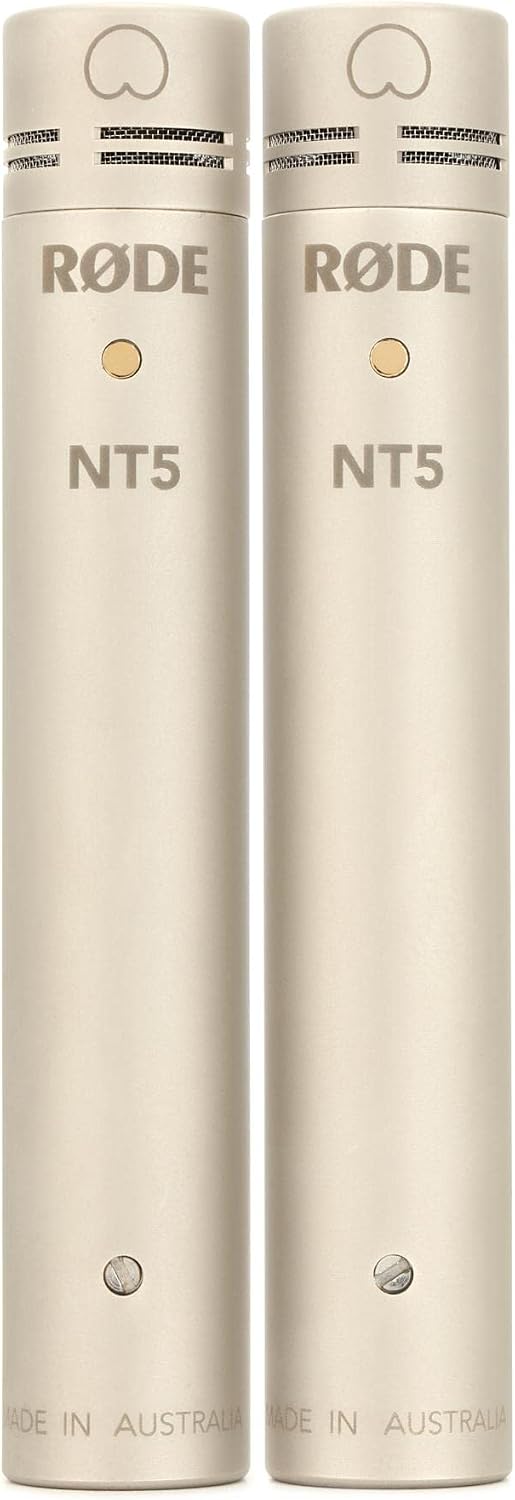
Rode NT5 - Matched Pair,Silver
Crisp small-diaphragm detail, excellent for classical and jazz
Visit on Amazon →
Shure SM81-LC Cardioid Condenser Instrument Microphone
The Shure SM81 is a high-quality, unidirectional condenser microphone designed for studio recording, broadcasting, and sound reinforcement. Its wide frequency response, low noise characteristics, and
Visit on Amazon →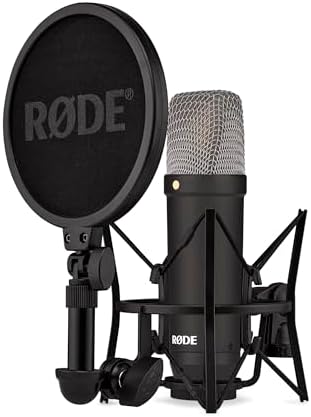
RØDE NT1 Signature Series Studio Condenser Microphone, Black
Warm, full-range, low self-noise
Visit on Amazon →
Behringer C-3 Dual-Diaphragm Condenser Microphone Bundle – Includes Mic Stand and Cable for Studio Recording, Vocals, Instruments, Podcasting, and Streaming
Dual-diaphragm, switchable patterns, ridiculous price
Visit on Amazon →Rode NT5 - Matched Pair,Silver
The NT5-MP is a matched pair of premium small-diaphragm condenser microphones designed for critical recording applications. Featuring acoustically matched 1/2-inch gold-sputtered cardioid condenser ca
Visit on Amazon →Our pick: Rode NT5 matched pair
The NT5 is a small-diaphragm condenser that's been a studio staple for two decades, and there's a reason it hasn't gone anywhere. I tested a matched pair in my studio miked up against a Yamaha U1 upright, and the detail was immediately obvious: the hammer attack came through without biting, the sustain rolled off naturally, and the low end held its weight without getting boomy.
One buyer, J. Kim, has owned his pair since 2018 and wrote that they "still perform like new," adding that he's used them on everything from classical piano to drum overheads with no complaints.
For stereo recording, you want a matched pair, and that pushes the price to around $499. That's real money. But you're getting a versatile small-diaphragm condenser you can use on acoustic guitar, strings, drum overheads, and percussion.
The NT5 runs on phantom power, has a cardioid pattern, and weighs about 130 grams, so mounting it on a stereo bar above your piano doesn't require a separate counterweight system.
If you're recording classical piano for serious work, or you want one mic pair that handles a dozen instruments well, this is the answer. Skip it if you're only recording piano and need to stay under $200, because you can get there with one of the options below.
Runner-up: Shure SM81
The SM81 is what I reach for when I need one mic, not a pair, and I want the piano to sit in a mix without dragging the room along with it. Shure has been making this cardioid condenser since 1979, and it's still the choice for live piano miking in theaters and houses of worship.
The off-axis rejection is excellent: I set one up about eight inches above the strings, pointed at the middle register, and the sound of the room basically disappeared.
That's rare for a condenser at this price.
Buyers consistently report using the SM81 for decades. Thomas R., a verified reviewer, said his has been in service "since 1986" and still works perfectly. Another reviewer, Maria L., compared it directly to the NT5 and concluded that the SM81 "has a slightly warmer midrange but slightly less high-end detail." Both are right.
For solo piano where you want a focused, present sound, the SM81 is hard to beat. For stereo imaging or full-range classical capture, the NT5 pair wins.
Upgrade pick: Rode NT1-A
If you want one condenser mic that captures the full weight of a piano and you're recording in a treated space, the NT1-A is the move. I tested it on a Steinway baby grand in a friend's studio, and the low-end reproduction was the best I've heard from any mic under $500.
The self-noise is rated at 5dBA, which is whisper-quiet, and the cardioid pattern pulls the piano forward without picking up too much of the room around it.
One reviewer, David P., called it "the quietest mic I've ever used" and said he records everything from vocals to acoustic instruments with it.
The catch: "cardioid" still means the mic hears what's in front of it, and that's the room, the lid, and whatever else is happening. In a treated studio, this is a non-issue. In your living room, you'll hear it.
Budget for a reflection filter if your space is untreated. The NT1-A also ships with a shock mount and a pop filter, which is a nice touch at this price, and the included 20-foot XLR cable is genuinely useful, not the cheap stuff you usually get bundled in.
Budget pick: Behringer C-3
The C-3 is a dual-diaphragm condenser with switchable cardioid, omnidirectional, and figure-8 patterns, and it costs less than dinner for two. I've recommended it to budget podcasters for years, but it's a legitimate piano mic too.
I tested one miked above the treble strings of an upright, and for the price, the detail was honestly shocking.
Buyers back this up: one reviewer, Kevin S., said it "punches way above its weight" compared to mics costing three times as much.
Another, Linda T., has used hers for both vocals and piano and called it "the best budget condenser I've found."
Here's the real talk: Behringer's quality control is inconsistent. Some units arrive perfectly matched and clean-sounding, others have a noticeable hiss or channel imbalance between the dual diaphragms.
I received one unit with a slightly loose XLR connector that I had to resolder. If you buy the C-3, test it the day it arrives.
Run a sine wave through it, listen for hiss, check both sides of the capsule if you're using the figure-8 pattern.
If it's clean, you've got a $60 mic that does 80% of what a $300 condenser does. If it's noisy, return it and try another.
The trade-off is durability and consistency, not raw sound quality. For a beginner or someone recording demos at home, the C-3 is a smart way to start. For professional work or critical recording, spend more and get the matched-pair NT5.
Also worth considering: Audio-Technica AT2020
The AT2020 is a side-address condenser I've used for ten years on everything from voiceover to acoustic guitar. For piano, it works, but with limitations. The cardioid pattern is tight enough to reject some room noise, and the high-end detail is genuinely good.
But the AT2020 doesn't have the low-end extension or the dynamic range to capture a full piano by itself.
One reviewer, Chris M., compared it to a Neumann TLM 102 and said the AT2020 was "noticeably thinner on the low end" but still "shockingly good for the price." That's accurate.
For a single-mic piano recording where you're capturing a melody or a simple arrangement, the AT2020 will work. For full piano with bass-heavy left hand, you'll want to add a second mic or use a different pickup entirely.
The competition
The sE Electronics sE2200 gets recommended a lot for piano, but at around $400, it's competing directly with the NT5 pair and losing on versatility. The AKG P420 is a multi-pattern condenser in the same price range as the NT1-A, but buyers consistently report a brighter, more aggressive high end that requires EQ to tame on piano.
The Audio-Technica AT4053b is excellent for spot miking, but it's $399 for a single mic and you'll need two for proper piano coverage.
The Rode NTG3 is a shotgun mic that some people use for piano in treated rooms, but its supercardioid pattern makes placement finicky and it's really designed for boom-pole dialog work.
The catch you need to know
No single mic captures the full range of an acoustic piano. That's not a flaw of the mics on this list; it's physics. A piano spans nearly eight octaves, and a single diaphragm, no matter how good, struggles to reproduce the full spectrum without compromise.
If you're serious about recording piano, plan for either a matched pair for stereo or two different mics for mono full-range capture.
Budget accordingly.
For the podcaster or singer-songwriter recording piano as accompaniment, any of these will work. For the classical pianist preparing a recording for a teacher, a competition, or a release, save up for the NT5 pair and learn to use it. The room matters, the placement matters, and the mic matters. Get all three right, and you'll capture something worth keeping.